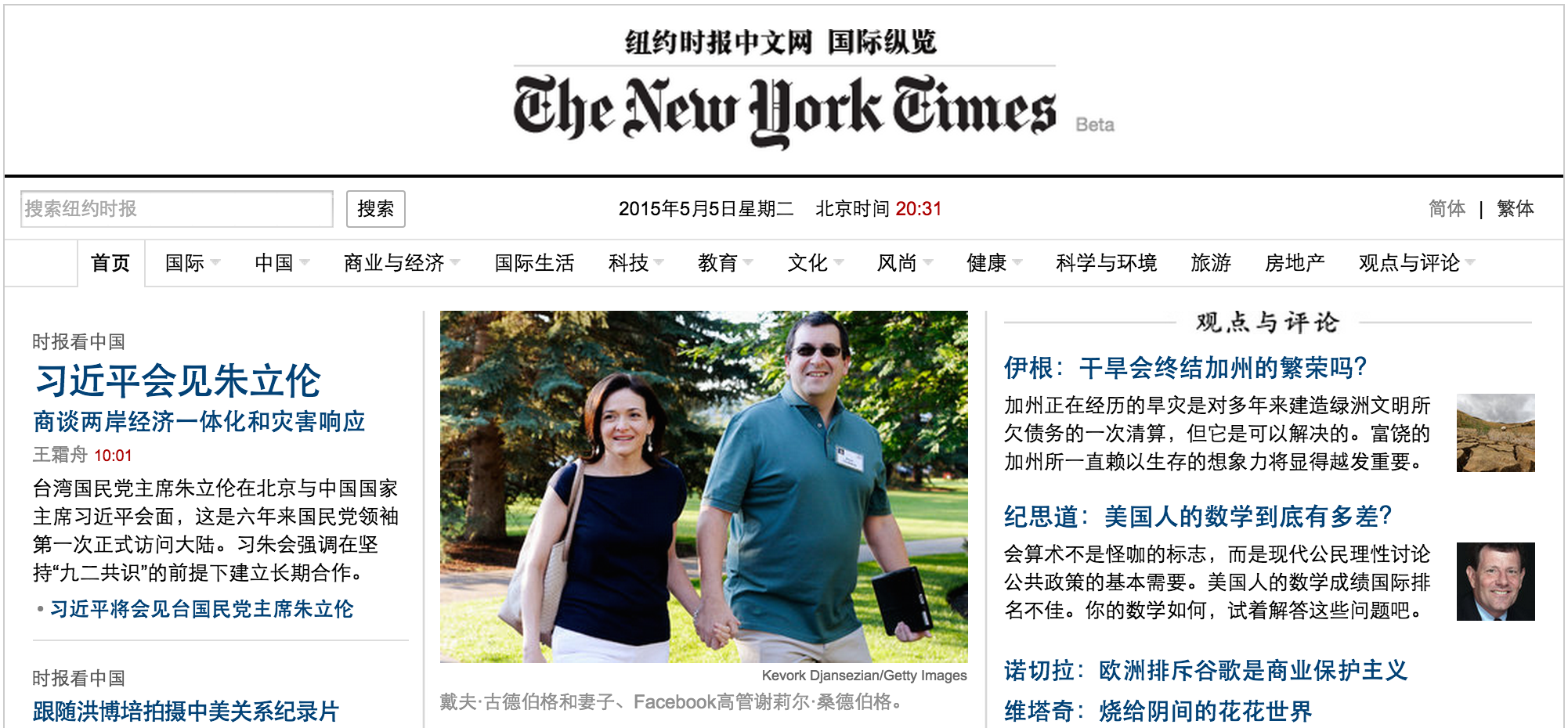
“[T]he first step in our new international strategy, which will extend the global reach of the Times and expand our international audience.“ - Arthur Sulzberger Jr.
Product Description
Launched on June 28th, 2012, the New York Times Chinese website is an attempt to cater to the Chinese-speaking readers and the huge market they represent. It has its own homepage, its own app, and its own staff. The site features more China-related stories, while providing international coverage, as well. There is also a nytStyle section, and the ads are in Chinese. The language it uses is almost like the Mandarin used in Mainland China. As long as readers sign up for an account, they can access the content for free.
Strategy
This product is a step toward the globalization of the New York Times brand. Adapting to one of the most commonly-spoken languages in the world will attract more readers from different backgrounds, explore new markets, and attract foreign advertisers. As NYT Media Decoder puts it, cn.nytimes is “intended to draw readers from [China]’s growing middle class, what The Times in its news release called ‘educated, affluent, global citizens.’” As Craig S. Smith said, China is the Times’ fourth-largest online market, behind only the US, Canada, and Great Britain. Other globalization efforts by the Times include:
- In 2011, the Times launched its blog India Ink, which mainly provided coverage on India. This coverage later folded into the broader global report on the International New York Times.
- In 2013, the International Herald Tribune, a Times Co. property, became The International New York Times, with editors based in New York, Paris, and Hong Kong. Its Spanish-translated articles fall under a section called “América.”
- On May 1st, 2015, The International New York Times and cn.nytimes launched the International New York Times Chinese Monthly: “a print publication that presents news, opinion and lifestyle content from The New York Times in Simplified Chinese for Chinese audiences in Hong Kong and Macau… The 24-page publication is available in luxury hotels, airline lounges, high-end residential complexes, premium outlets and on newsstands,” states the company’s press release.
Key Features
Bilingual View
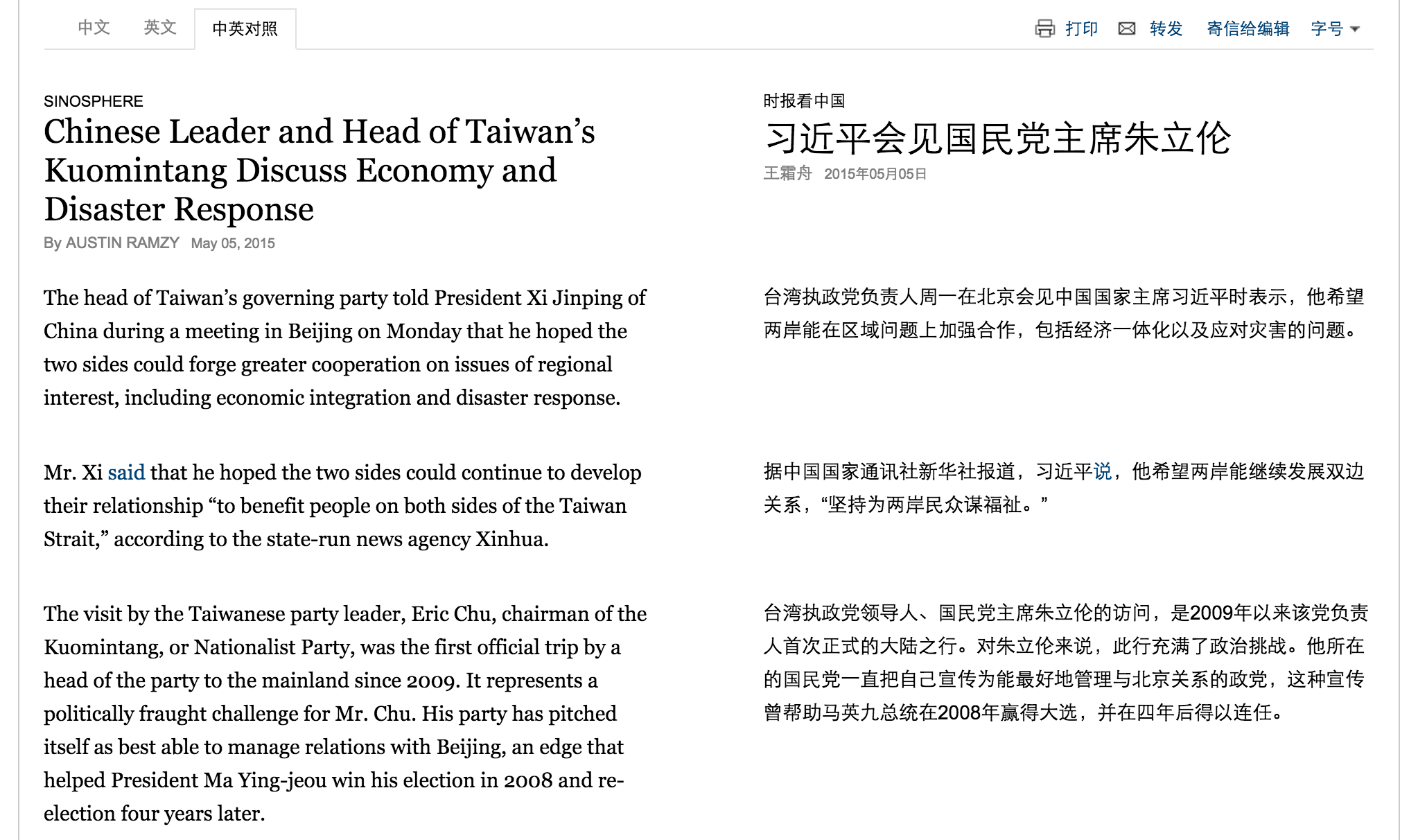
While reading a cn.nytimes article, the user can choose from the original English version, the Chinese version, and the bilingual version of the article, which puts the English version and the Chinese version side by side.
Character Choice

Chinese readers can choose from simplified Chinese characters and traditional Chinese characters. Once a choice is made, whenever a user comes back to the homepage, that specific type of characters are presented. This is an attempt to include readers that do not read simplified Chinese characters, which is the default setting of the website.
Weekly Newsletters
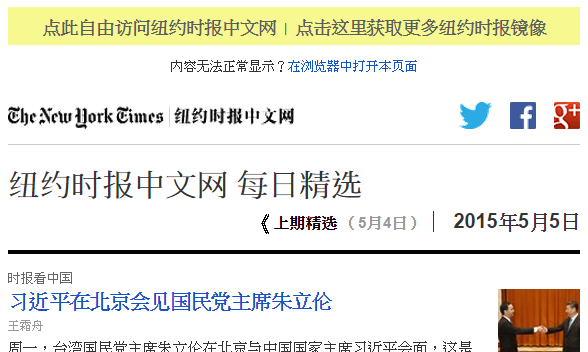
Readers can sign up for free daily newsletters which offer editor-picked articles from the website.
Slideshow of the Day
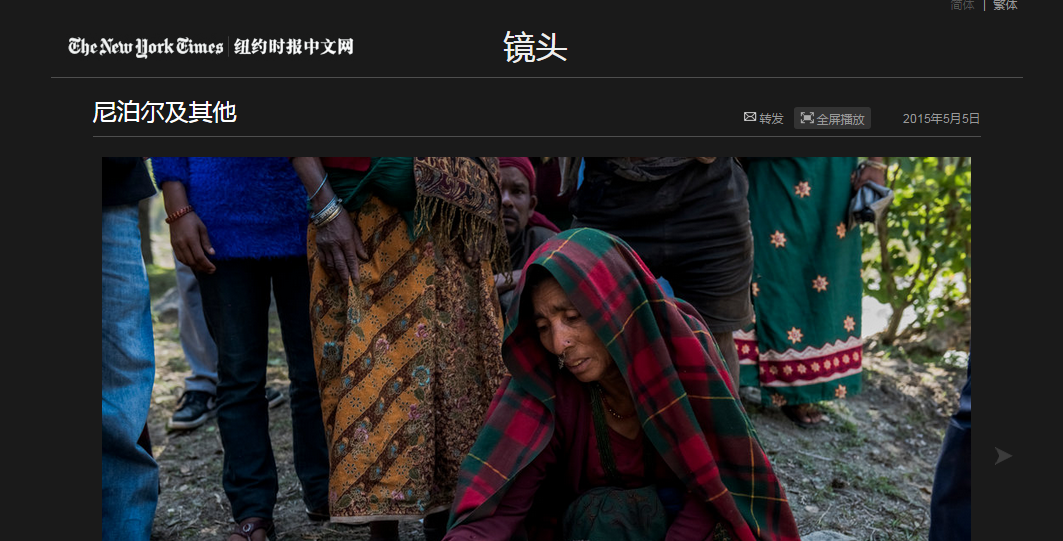
Unlike the original English version of the NYT website, cn.nytimes has a daily slideshow on its homepage, which usually consists of seven pictures that tell seven different news stories with a sentence or two describing it at the bottom.
Popular Articles of the Day/Week
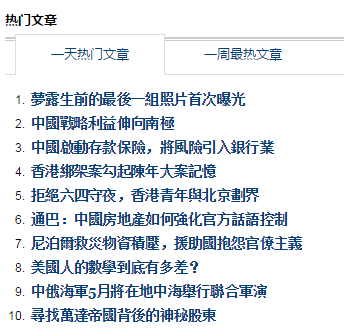
Unlike the original English version of the Times website which gives daily lists of Most Emailed, Most Viewed, and Recommended For You, cn.nytimes has two lists running on the home page: Popular Articles of the Day and Popular Articles of the Week.
Videos

Videos can also be viewed from the cn.nytimes home page. The English-language videos have Chinese subtitles.
Key People
- Joseph Kahn: Foreign Editor, based in New York.
- Philip Pan: Assistant Foreign Editor, based in Hong Kong.
- Ching-Ching Ni: Editor-in-chief, based in Beijing.
- Craig S. Smith: Managing Director, overlooking the business side of the website. Based in Hong Kong.
Competitors
Western News Organizations with Chinese Websites
- BBC Chinese: Has a much more engaging homepage with bold titles and big graphics. The Taiwanese section on the site posts at least 8 articles in one day, almost 1/3 of cn.nytimes’ total articles a day
- Financial Times: Claims to have 1.7 million users, targets specifically at business news
- The Economist: Has a comment section, targets specifically at business news
- The Wall Street Journal: One of the firsts to set foot in the Chinese market with a very informative website as breaking headlines run through the top below the section tabs; features multiple languages other than English and Chinese to be easily switched between, and targets specifically at business news
Local Asian/Chinese News Outlets
- baidu.com: A Chinese searching engine that also provides news, especially local news; the home page has a relatively small header with almost no ads, with a carousel running on the side for breaking news.
- qq.com: A Chinese social media platform that also provides news, especially local news, and is popular among younger readers; the home page also has a relatively small header with lots of text broken into different sections, with ads on the side.
- Worldjournal.com: Popular among Chinese speakers in the U.S. with up-to-date immigration-related policy issues. Features both Asia news and U.S. news. The site has lots of localized ads which might be distracting; the carousel in the middle not only shows breaking news but also the rundown of news events in the past 12 hours.
- United Evening News: A Taiwanese newspaper that translates the Times’ syndicated content.
How It’s Doing
- In October 2012, after the publication of this article — on the then Chinese Premiere Wen Jiabao’s illegally gathered wealth — both the English and Chinese website of the New York Times have been blocked by the Chinese government. The official handles of the NYT and its reporters on various Chinese social media platforms have also been blocked. It is not clear whether the Times anticipated this outcome in publishing the article, but it is not the first Western news outlet blocked by the Chinese censorship. Since 2012 the incident, the Chinese government has not given the NYT any definitive end date for the blockage.
- Around November 26th, 2013, there were speculations that cn.nytimes might close down due disappointing business results. “The fact that we can’t be seen officially inside China means the revenue is not as large as we would have wished it to have been,” Mark Thompson, NYT CEO said. “If it’s a loss-making operation, they are all under constant review.”
- On March 20th, 2015, websites mirroring cn.nytimes came under attack. While the identity of the attackers is unclear, it is speculated that the hack was connected to Chinese government censorship.
How It’s Made
Staff
The site has staff based in Beijing, Shanghai, and Hong Kong, as well as seven reporters based in Mainland China. The staff size is around 35 people, which mainly consists of editors and translators.
Articles
The site puts out an average of 30 articles per day, a third of which are written by Chinese editors and freelancers, while the rest are translated from the Time’s English-language edition.
What It Does Well
Based on reports from the users we surveyed, the most appealing features of the site are:
Content
NYT journalism, including the content on cn.nytimes, is presented in a relatively objective and precise voice, which makes it credible for Asian-related U.S. news.
Design

The nytStyle section is well-designed and visually-appealing with a picture-oriented carousel running in the middle.
Language
One of the key features, the bilingual version, not only gets rid of the skepticism of biased translation, but also creates an educational opportunity for the reader to go back and forth between the two languages.
Price
The website and all of its features are free to use so far. As the Times’ former chief advertising officer, Denise Warren, puts it, ”Th[e pay wall]’s something that potentially down the road we contemplate,” she said. ”We have to give [cn.nytimes] the opportunity to flourish first.”
Ads
There are relatively fewer ads on cn.nytimes compared to local Asian news outlets.
What It Does Poorly
Based on user experiences, the following are areas for improvement on the site, including issues which might cause friction for new users:
Content
There is not enough variety in the content provided. This might be due to the limited staff size; not enough reporters, editors, and translators to produce more updates and new articles.
- The same article will appear under multiple sections.
- nytStyle main page still has articles from 5 days ago.
- Articles on Hong Kong, Macau, and Taiwan under the China section are added at the rate of 1 article per week on average. That’s not frequent enough. (For the period in which this review was conducted, the following were the dates when articles were added to the section: April 14th, 1st, March 30th, 23rd, and 18th).
- The homepage does not update during the Chinese nighttime.
- Translated articles can be ten months~1 day old after the English version is written. The site sometimes shows when the original English article is initially published, but sometimes doesn’t.
Design
Parts of the site are unappealing and difficult to use.
- Homepage design is visually unappealing, with blocks of text taking up too much space compared to pictures.
- Depending on different font sizes to differentiate between headlines and subtitles makes the separation unclear.
- Users have to create a separate account from the original English website’s account for cn.nytimes. Why?
- The is no button to directly contact a reporter in the byline of articles.
- There is no comment section.
- cn.nytimes is designed to open up new tabs for every new section, article, or picture.
Language
The language cn.nytimes uses is rigid and can be incomprehensible to certain Chinese speakers. This might be due to the fact that with the limited amount of staff, some articles are poorly translated, and that the targeted market is the Chinese speakers in Mainland China, which prompts the language of the site to cater more towards their usage.
- Some articles are so rigidly translated with terms that even Mainland Chinese speakers could not understand, which almost contradicts Foreign Editor Joseph Kahn’s statement that, “the bulk of [cn.nytimes’] staff will work on translation, which requires more than simple word matching.”
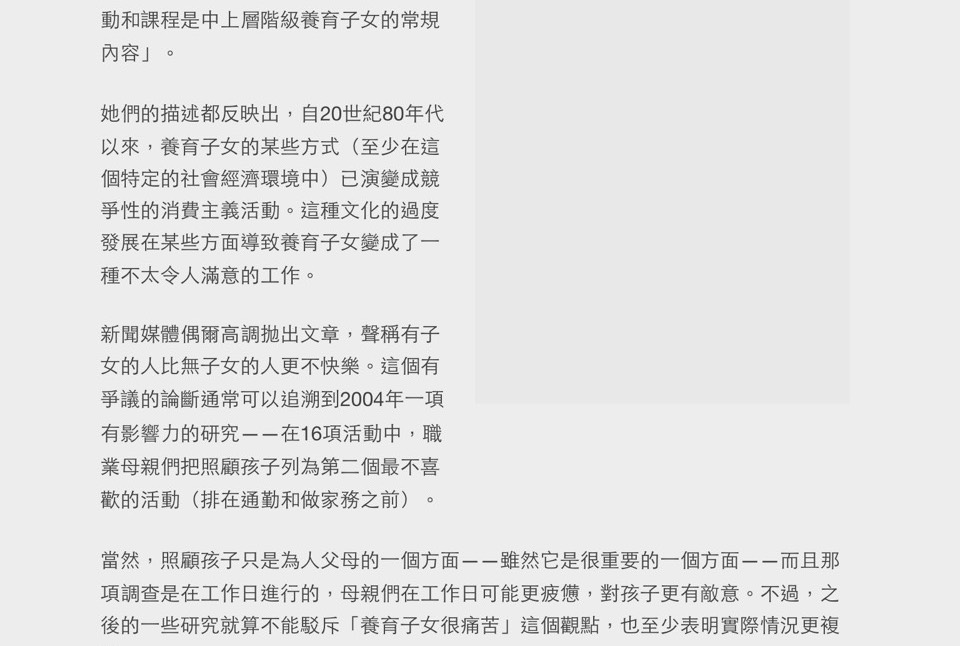
- When traditional Chinese characters, which are mainly used outside of Mainland China, are chosen in the setting, the language usage is still the tone of the Mainlanders’, which can be very confusing and unattractive to readers living outside the area. It’s a strange mix.
- Even though the option of switching between simplified and traditional Chinese characters is provided, the switching process does not always work smoothly. Certain links, ads and buttons still remain in simplified when the traditional is selected; links that were copied in traditional ends up being in simplified after shared; a user could originally be on the traditional character setting but the articles turned into simplified when switched to bilingual version of articles.
- The language used in the bylines is inconsistent. On the same homepage, users can see all of the following: English bylines translated into Chinese, English bylines that remain in English, and Chinese bylines that remain in Chinese.
Ads
The quality of ads can also be inconsistent.
- Some ads are unsophisticated and presented with low resolution.
- Some ads do not show up on the iPad app sometimes:
Bugs
Several bugs were encountered during this product review.
- In the video above, when the user tries to load more articles on an Android phone using Chrome, the website loads the same sets of stories over and over again. (Tip on following the video: focus on the very last story that includes an “8” in the headline and “Airbnb” in the first line of the summary, and you will see it appear again every time the user gets to “load more”.)
- Another user could not register or log in with a MacBook using Safari.
Where It’s Going

The Times has tried to maintain a positive attitude towards the expansion of cn.nytimes in China— despite the government’s attempt to block it. As Managing Director Craig S. Smith puts it, “The day those restrictions are limited—and the government assures us every time we see them that this is a temporary situation and things will normalize—China will be the largest digital market outside the US.” On the growth of readership, he says, “We’re now back to about where we were before the restrictions set in October of 2012, and we’re still growing.”
There are four ways the Times is currently trying to deal with the efforts to block their site:
Mirroring
Creating new websites that can spread copies of cn.nytimes’ articles. Once those websites are censored, continue cropping up new websites.
Using Apps
The apps created are branded with NYT’s name, and it usually take weeks or months before being blocked, a time length that is relatively long compared to the frequency of websites blocked.
Pushing News via Social Media
Since the official NYT’s and reporters’ handles are all blocked on social media, NYT keeps on reinventing new handles to spread links to their articles when old ones are blocked, playing the so-called “cat-and-mouse game”.
Syndicating to Local Websites and Newspapers
Some local news outlets, such as QDaily in Beijing, purchases rights to run NYT articles, which would partly increase the limited revenue sources in China.
Users Said…
- “There are just way too many tabs way too quickly” - A Chinese college student studying at NYU, on the design of the website.
- “Great, since I don’t understand English, I can now read the Chinese version of the New York Times.” - A newspaper editor from Anhui, on the launch of cn.nytimes.
- “The ads look like counterfeits [from the original English website]”- A Taiwanese American high school student studying in Taiwan, on the low quality ads.
- “There’s FT, The Wall Street Journal, then the New York Times. The competition in Chinese websites is growing, benefiting the readers.” - Zhang Xin, CEO of SOHO China, on the launch of cn.nytimes.
- “The level of their translated English articles does not even meet the work of a college graduate. The level of their original Chinese articles are not even proofread. I don’t understand how a world-class New York Times can make such a bad Chinese website.” -zhangtschao, a statistical consultant in Singapore, commenting on the language usage of cn.nytimes.
Key Links
- Chinese Website of New York Times
- Future New York Times, “Making the Times into a Global Product”
- NYT Media Decoder, “Times Broadens Its Reach With a Web Site in Chinese”
- BBC, “Chinese Online Users Welcome New York Times Chinese Website”
- Nieman Lab, “Krugman, translated: The Promise and Risk of The New York Times’ Chinese-language Site”
- New York Times, “China Blocks Web Access to Times After Article”
- Reuters, “New York Times CEO Says Chinese language Site Under Review”
- Quartz, “How the New York Times is Eluding Censors in China”
- The Economist, “Great Walls of Fire”
- Editor and Publisher, “The International New York Times Chinese Monthly Launches in Hong Kong and Macau”

